


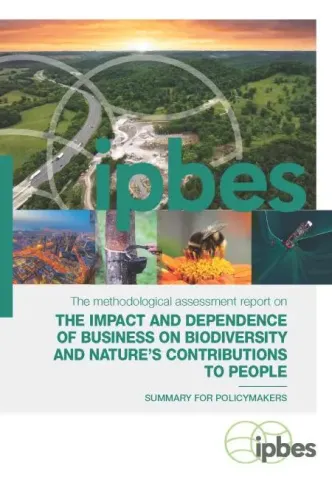
This assessment is the first IPBES report produced specifically to address the private sector. The report was developed over 3 years and by 79 leading experts from 35 countries. It synthesises over 5,000 references and categorises how businesses and financial institutions both depend on and impact biodiversity and nature's contributions to people. The report also evaluates the methodologies available to measure those relationships.
The report introduces 3 typologies for understanding business-biodiversity relationships. It proposes 3 criteria for selecting appropriate assessment methods:
- coverage (geographic extent and scope of impacts/dependencies captured)
- accuracy (degree to which results correctly describe reality)
- responsiveness (ability to detect changes attributable to specific business actions).
A central finding is that no single method is appropriate for all impact types, sectors, or locations.
The assessment identifies 5 categories of knowledge gaps:
- business-relevant data
- data accessibility and transparency
- completeness of evidence
- adoption of methods
- applicability of methods
The assessment provides over 100 concrete examples of actions for businesses, governments, financial actors, and civil society to address these knowledge gaps. Particular attention is given to the need to recognise and engage Indigenous Peoples and local communities as biodiversity stewards.
About the Publisher
The Intergovernmental Science-Policy Platform on Biodiversity and Ecosystem Services (IPBES) is an independent intergovernmental body. It was established by 94 governments to strengthen:
- the science-policy interface for biodiversity and ecosystem services
- the conservation and sustainable use of biodiversity
- long-term human well-being and sustainable development.